Welcome Friend
Cart is empty Subtotal: $0.00
Los Carneros
2012
Tasting Notes
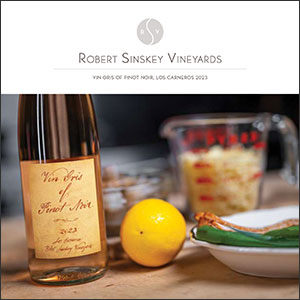
Stunningly beautiful to the eye with a gem-like glimmer, this whole cluster pressed rosé of Pinot Noir exhibits delicate purity. Aromas of pear and wild strawberry dance from the glass as complex flavors of mineral and herb co-mingle with a vibrant mouth-feel—an absolutely refreshing experience! This Vin Gris of Pinot Noir is an incredibly versatile wine to pair with food as it can stand up to the more extreme of ethnic cuisines—Asian, Mexican and Indian—yet it is completely comfortable with a simple sandwich or classic French bistro fare.
Purchases are limited to one case.
Stunningly beautiful to the eye with a gem-like glimmer, this whole cluster pressed rosé of Pinot Noir exhibits delicate purity.
Aromas of pear and wild strawberry dance from the glass as complex flavors of mineral and herb co-mingle with a vibrant mouth-feel—an absolutely refreshing experience!
This Vin Gris of Pinot Noir is an incredibly versatile wine to pair with food as it can stand up to the more extreme of ethnic cuisines.
Positive Vibrations...
Tribulations of the non-conformist!
I’ve been accused of being a bull-headed, non-conformist with a bad habit of shooting myself in the foot by not playing the media game. We all desire some sort of affirmation, but at what cost? We’ve found that once you go down the accolade trail, you have no choice but to set aside your good, natural instincts in exchange for technique driven mediocrity and, although you may achieve short term success, you risk making yourself, and those who care, very unhappy.
About twenty five years ago, when I was fresh out of school and enjoying our coming out party in the wine industry, I had three distinct experiences with the wine media. One very powerful critic claimed to have tasted a barrel sample of one of our wines and proceeded to trash it in print, yet he had never been in our cellar. He then went on to rave about our Russian River Pinot Noir, yet we had never made a wine from that region. Not long after, a very powerful wine magazine assured me the advertising department was next door to the editorial department and went on to imply that an ad would just about guarantee a good score. I felt as though I had just lost my innocence, but I also came away feeling we needed to go it alone and not “grow-up” in public by chasing someone else’s ideal of wine style. Instead, we needed to define our own place in wine.
So we took our toys and went home by refusing to send samples to the evil empire of wine critics. But there was one wine writer—a writer as opposed to a critic—who did not seem to mind our anti-social ways. In one of our early wine events, I sat next to Dan Berger who I believe was then writing for the LA Times. He proceeded to tell me that our wine would not be very popular, but then encouraged me to not change a thing because, eventually, the market would find us. It was all I needed to give me permission to chart our own course.
We still don’t send wine samples to critics, but Dan has taken it upon himself to stay in touch with what we do by visiting the winery, talking to RSV winemaker Jeff Virnig and tasting through all the wines. The following from Dan Berger’s Vintage Experiences Volume XVI, Issue 47, January 24, 2013, gives me all the positive reinforcement I need.
A Winery Synthesis
People usually decide to start a winery because they have a vision of what they want to do. But visions vary. A recent wave of interest seems to be with people who want to make the best Pinot Noir in the history of the world. So a lot of cool-climate land was planted with Pinot Noir, including marginal places.
Two decades earlier, any place in Napa Valley (and I mean any) became home to those who wanted to make a wine better than Château Latour. But instead some people ended up making a wine that was merely half as pricey...
Sure, young wineries often get high praise from glossy rags or number based prognosticators, but mostly that’s for the shock value.
It’s hyperbole such as this: “Hey, bro, I just found this fantastic, tiny property you never heard of that makes roughly no wine at all. Well, I tasted it, and believe you me, it was absolutely fantastic. But sorry, you’ll never get a chance to try even so much as a thimbleful because after the score I give it, the price will rise so fast that only the stupidly rich will be able to afford it and they will buy all of it, so just drool and slather. Nyah.”
One visionary concept guaranteed not to gain klieg-light attention is to make wines defined by terroir that speak directly of the soil and which are specifically designed to pair with what comes directly from the kitchen.
Such projects rarely start with the goal of exalted wine. The idea is to focus intently on what nature permits from an area, and to craft wines with exceeding precision.
I can name many U.S. wineries who get this notion clearly. Decade after decade these wine makers hew to a house style that’s reliable and give loyal consumers a taste of the vision.
Most are small wineries who are not saddled with a marketing strategy that demands the wine maker soften all the wines for a broader market. They make wines for a more savvy consumer and in fact some of these projects make wines that are edgy, delicate, and atypical of the huge 95-pointers intended to impress with power.
Those who craft wines with a deft hand lift my spirits. Amid a flood of too-soft wines, these backers of crisp offer those of us who like balance much hope.
A vision of varietal identity and balance usually connects a wine maker with his vineyard manager. But at organically farmed Robert Sinskey Vineyards in Napa Valley, this synthesis includes the founder, Dr. Robert Sinskey his son, Rob, Rob’s wife, Maria, wine maker Jeff Virnig, and the vineyards they own...
What’s special about all of this is that, were it not for all of the parties involved, the wines would not be so singularly exciting to those who get what food-and-wine pairings are really all about. It starts with varietal authenticity and ends with a crisp finish so the food synthesizes with the wine.
It really started with Dr. Sinskey, an eye surgeon, inventor, and one of the world’s most respected ocular experts. He also is a long-time wine collector who relishes opening old, perfectly stored wines and pairing them with great food. Much of which comes from Maria Helm Sinskey, his daughter-in-law, superb chef and cookbook author.
The person who keeps it focused on the table, and on balanced wine is, Rob, who was well trained in the classic wines of the world and who requires no compromise in the house style.
Thus lots of new oak or modest acid levels aren’t in the game here. As a result, it wasn’t an accident that the Sinskeys ended up with Virnig as their wine maker—a guy who not only gets the balance thing, but whose hatred for flabby wines has had him far too vocal on the subject for his own good.
This sort of Sinskey synthesis leads to a structural integrity for all the wines but doesn’t come without a price. One of which is how low such wines are likely to score with some reviewers. That’s because no Sinskey wine is plush, simple, or easy to quantify, and certainly not as simplistically as what a numerical shorthand tries to do. Here it’s about complexity... These wines are unlike so many others we find that are boringly mainstream. Virnig’s vision includes his ability to bring an edginess into a wine that others would gladly (and happily) compromise.
What I love about these wines is that they’re distinctive. It shows best in most of Jeff’s reds, almost all of which are uncompromising in their structural balance—almost to the point of absurdity.
Take for instance any vintage of Marcien, a blend that is tart and lean, yet a perfect vision of the best reds of the 1970s, before the compromisers got their hands on the double oak, potassium carbonate, and micro-ox machines.
Marcien, as with other Sinskey wines, are built to stand up to time and food and display the grape variety and the soil.
The only question is: how much of these wines must a dedicated wine lover have to be assured that the boringness of a 95 can be avoided when the victuals demand.
For me, it’s never enough. White, red, or rosé, they are all A+.
A Rosé to Get
One of wine’s inside stories is the popularity of dry rosés and how fast they sell in winery tasting rooms.
Literally dozens of wineries around California make superb dry pink wines and sell them direct to visitors—most of whom taste them and then must have a bottle, or a case.
Robert Sinskey’s greatness in this area is a sub-story that’s hard to believe. The winery’s dry Pinot Noir Rosé from Carneros is among the best made anywhere in the world.
It always has such vibrant fruit and balance that it sells out every year...
I had a pre-bottling sample at the winery late last week and found it as good as the best rosés I have ever had. The wine will be on strict allocation, and I suggest orders be placed with the winery. At about $28, it should be tried by every serious wine lover.
Pink Pleasure
RSV’s delicately pressed Vin Gris is a sensually aromatic rosé with vivid notes of white wild strawberries.... It’s so crazy!! This beautiful rosé’s vibrant acidity makes it pleasing on the palate and a great match for food. Surprisingly, this delicate rosy-hued wine stands up to assertive spices like Merguez spice from Spain. Typically this spice is used to make classic Spanish Merguez lamb sausages, but I wanted to expand its horizons and so reached out to land, sea and air. All of these dishes sing with the wine. Stash a bottle of Vin Gris in your picnic basket alongside the crunchy Merguez fried chicken. It will heighten the pleasure of dining plein air. I think that’s what the Vin Gris is all about - PLEASURE.
Until the Next Wine....
Maria
EAT: Crunchy Merguez Chicken
EAT: Merguez Style Baby Back Ribs
EAT: Grilled Wild Shrimp with Merguez Spice
EAT: Spicy Manchego Potatoes
EAT: Merguez Spice
Out of the past 25 years, there has never been such an idyllic vintage as 2012. After the scare of a record dry winter, a March miracle provided the precipitation needed to fill up the reservoirs. This late moisture was followed by some quick work to catch up on canopy management, then a nice spring set, moderate heat, a long growing season, and a relaxed harvest... as close to perfect as ever could be. The fruit developed wonderful flavor as it slowly ripened and was able to be picked at lower average brix (sugar) than the last few years, making for full-flavored, yet balanced, wine that exhibits a nice, long, mouth-watering finish.
© Robert Sinskey Vineyards
100% Certified CCOF Organic and Demeter Biodynamic Vineyards
Robert Sinskey
Tiffany Barber
Paolo
Jennifer Gallagher
Beth Gustafson
Meg Barkley
Debby Zygielbaum
Bob Sinskey
Maria Helm Sinskey
Jeff Virnig
Zach Gabbert
Christopher Patrick O'Hearn
Farm to Table Experience
Walk in and Taste at the Bar